Fora
String quartet • 2022 • 11'
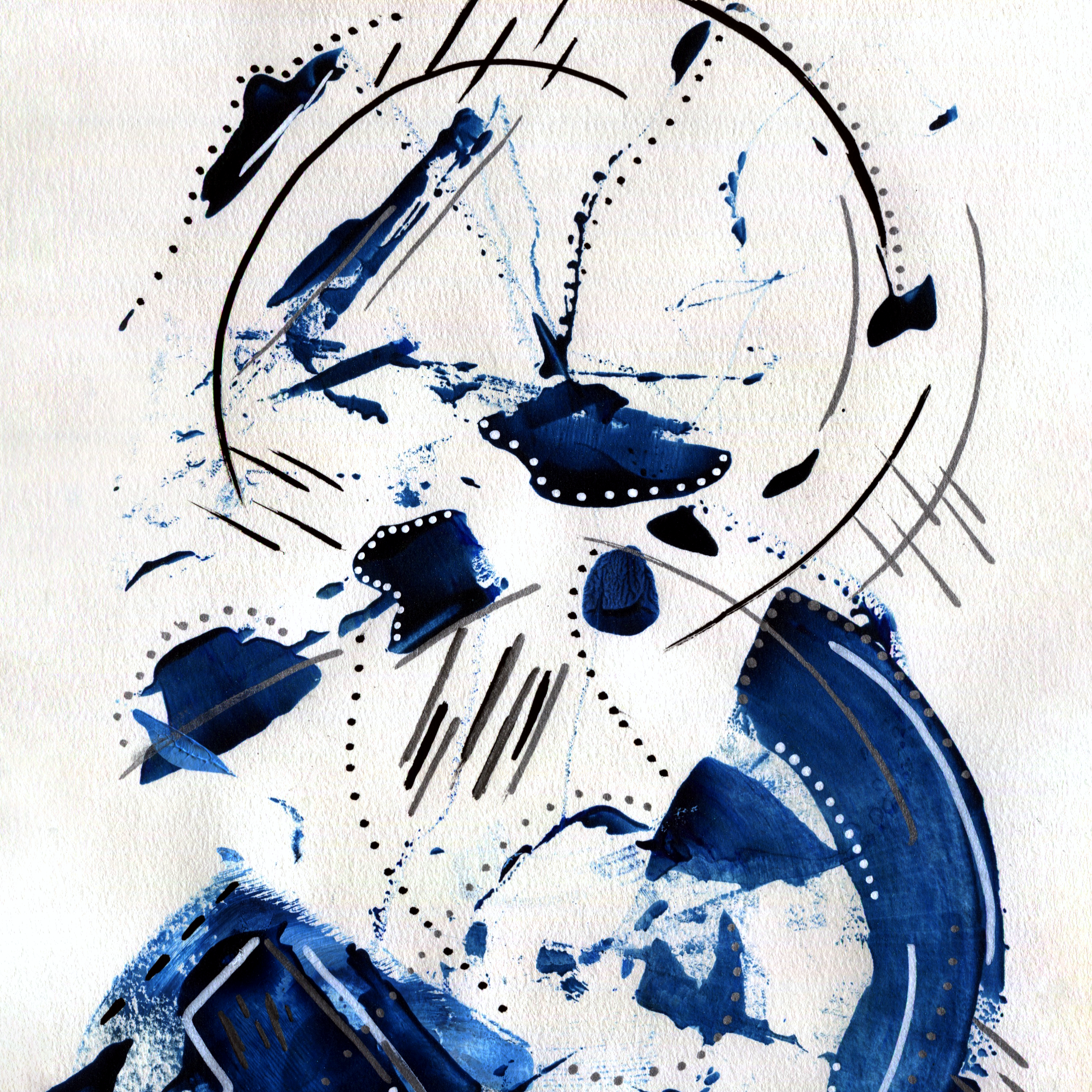
Artwork by Stephanie Swilley
Program Note
Fora (2022), for string quartet, was composed for Sang Koh and the University of Northern Iowa Faculty String Quartet. The work is an intermingling of several ideas – fora is a plural form of the word forum, which can be interpreted as a bringing together of ideas. These fora occur in terms of the programmatic elements as well as composition methodologies used in the work.
The program for Fora is focused on various forms of divination. Isopsephy was used to determine structural division, as well as a way of connecting programmatic elements of different movements. Isopsephy is the practice of adding up the number values of the letters in a word to form a single value and is used in some divination practices. The words opal, knife, tear, match, hope, and rate all have the same isopsephy value and their own associated divination history/practices/lore that were referenced for composition decisions: “Opals in her hair” is a Sir Walter Scott Anne of Geierstein Reference. Macharomancy is a form of divination by interpreting knives, daggers, or swords – “tears will turn to joy” is one of the common determinations. Magic squares have been used for divination in many cultures. This is related to numerology and is just one of many forms of divination that focuses on interpreting number sequences or ascribes significance to numbers.
The various methodologies and techniques for music composition can be thought of simply as tools - each produces music with qualities depending on source material and approach. A composer can select the best tool for a given task or based on a desired output. Also, by using the same source material as a departure point, these various tools can be used as a way of development through recontextualization. Fora is an exploration of this notion of development as well as a freer approach to combining different methodologies within a work. Some of the methods used include several approaches to isorhythm, rhythm fractioning (Schillinger), set theory, interval cycles, rhythmic cycles, neo-Riemannian transformations, automata, serial processes, tintinnabuli, infinity series, and sonification.
Fora is a continuation of the composer’s research into computer-assisted algorithmic composition. It was composed with use of the software Common Music/GRACE and Max.
Movements
- Opals in her hair
- A knife, tears will turn to joy
- Match - numbers and magic
- Hope rate
Performance Information
Performance information coming soon.